TLDR
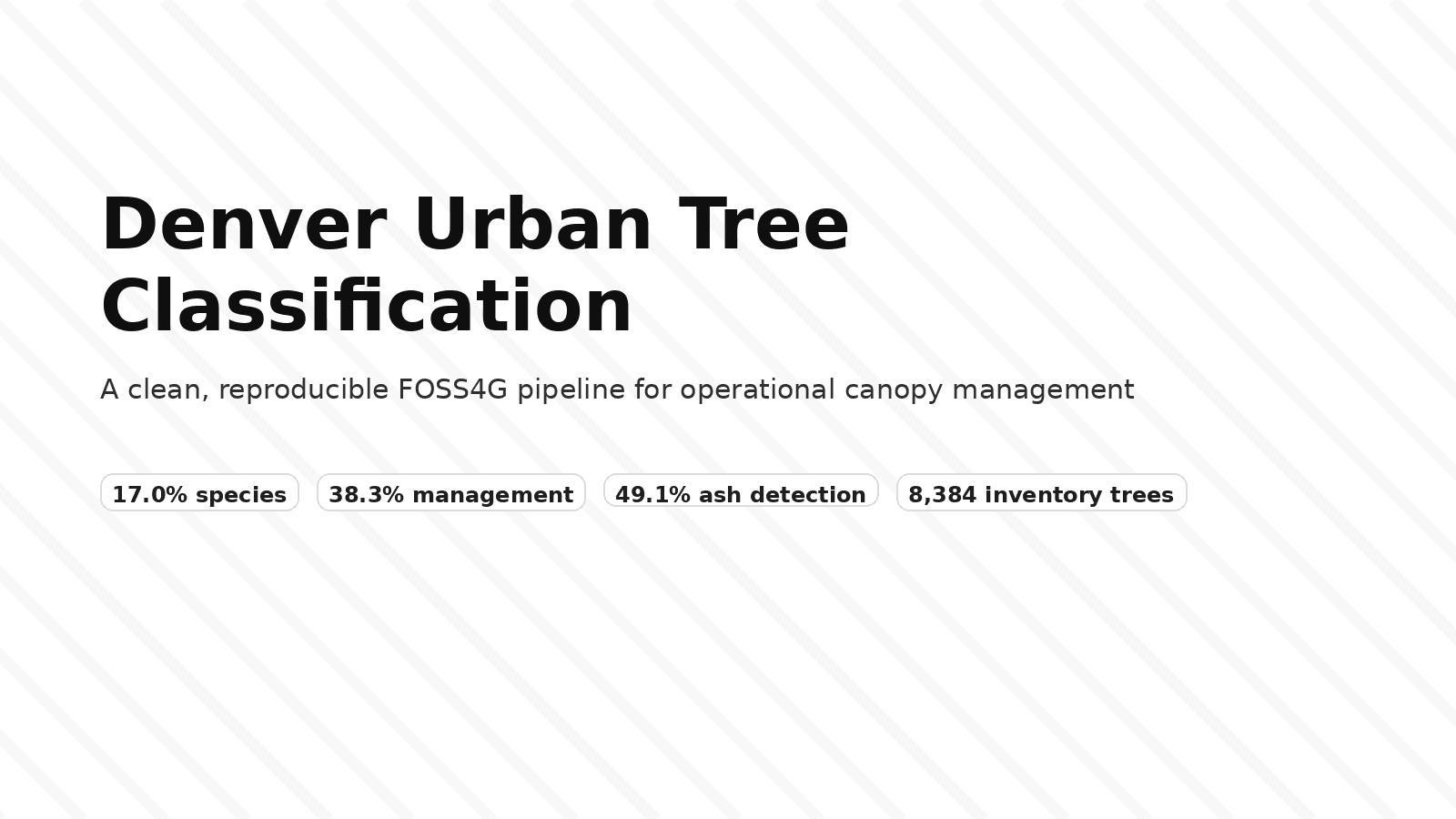
Free 4-band imagery cannot reliably identify urban tree species in Denver at an operational level. Species classification reached 17.0% accuracy (524 correct out of 3,088). Reframing the task into five management classes improved accuracy to 38.3% (1,183 out of 3,088), with 49.1% accuracy for identifying ash trees prioritized for Emerald Ash Borer treatment.
The problem
Urban forestry workflows need prioritization, not perfect taxonomy. The core question is whether freely available imagery can produce a decision useful signal for canopy management.
Data
- •Sensor: NAIP, 0.3m, 4 bands, September 2023
- •Study area: Denver, Hale neighborhood
- •Evaluation set: 3,088 trees across 10 common species
- •City inventory context: 8,384 trees in the study area
Method
I implemented a spectral signature approach using band-sample values per tree and assigned each tree to the closest class in spectral feature space (minimum distance). I evaluated results with confusion matrices and overall accuracy. After species performance failed, I introduced a hierarchical management framework that reduces ten species into five operational classes aligned to treatment and monitoring priorities.
What failed and why it matters
Species-level accuracy was 17.0% overall, with extreme variability by species. Some species show clearer separation, but many deciduous species blend spectrally under 4-band imagery. This is not a small tuning issue. It is a constraint of limited band information plus urban canopy variance.
The reframing that worked
Instead of asking "what species is this tree", I asked "what management action does this tree imply".
Management classes:
- •Ash EAB Risk
- •Elm DED Risk
- •Conifer Drought Tolerant
- •Maple WaterDemanding
- •Other Deciduous
This reframing improves signal quality and preserves decision relevance.
Results
Management view:
- •Overall: 38.3% (1,183/3,088)
- •Ash_EAB_Risk identification: 49.1% (369/751)
Management classes:

Ash, EAB risk

Elm, DED risk

Conifer, drought tolerant

Maple, water demanding

Other deciduous
Operational takeaway
The contribution is not a higher species score. The contribution is demonstrating a fundamental limitation and providing a practical alternative that produces usable prioritization.
Limitations
- •4-band imagery constrains species separability
- •Urban canopies introduce high within-species variance
- •This approach does not replace field survey, it targets it
Reproducibility
Code and processed outputs are intended to be published as an open pipeline with figure regeneration scripts and documented steps.
Resources
- Code: Available in repository
- Data: NAIP imagery, Denver city inventory
- Figures: Generated via Python script (scripts/generate_denver_canopy_assets.py)
Management classes:
Ash, EAB risk
Elm, DED risk
Conifer, drought tolerant
Maple, water demanding
Other deciduous