Geospatial · Remote Sensing · 2026
Denver Urban Tree Classification: Mapping a Neighborhood's Canopy from Free Imagery
I mapped 18,272 tree crowns in Denver's Hale neighborhood from public aerial imagery, a five-date Sentinel-2 series, and airborne LiDAR. The model sorts each crown into one of five forestry management classes. It supports screening and field prioritization; it does not replace an arborist survey.
The project began in an AMS course taught with NASA and CIRA, then expanded into crown segmentation, spatial validation, and model comparisons.
Tom Shanks
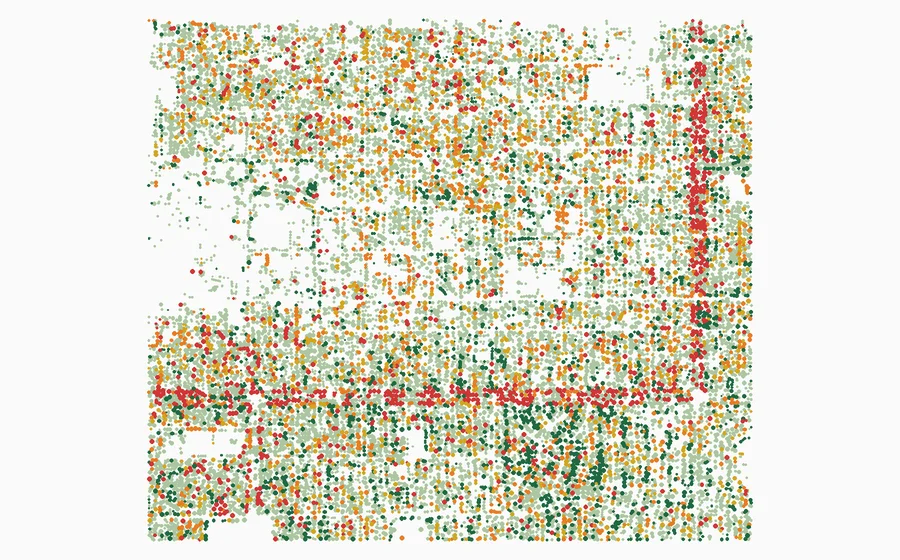 Plan · 2.57 × 2.22 km · north ↑
- 0–<6 m2,96916.2% of records
Other deciduous: 2,655 · conifer: 231
Class counts
- Ash (EAB risk)
- 19
- Elm (DED risk)
- 7
- Conifer
- 231
- Maple
- 57
- Other deciduous
- 2,655
- 6–<12 m6,52035.7% of records
Other deciduous: 4,614 · conifer: 743
Class counts
- Ash (EAB risk)
- 659
- Elm (DED risk)
- 35
- Conifer
- 743
- Maple
- 469
- Other deciduous
- 4,614
- 12–<18 m5,80931.8% of records
Other deciduous: 3,299 · conifer: 858 · ash: 841
Class counts
- Ash (EAB risk)
- 841
- Elm (DED risk)
- 125
- Conifer
- 858
- Maple
- 686
- Other deciduous
- 3,299
- 18 m+2,97416.3% of records
Other deciduous: 1,023 · elm: 995
Class counts
- Ash (EAB risk)
- 106
- Elm (DED risk)
- 995
- Conifer
- 525
- Maple
- 325
- Other deciduous
- 1,023
18,272 exported crown records · height is each crown’s maximum in the LiDAR-derived canopy-height model. Classes are model predictions. Bands use unrounded heights; 12 zero-height records remain in 0–6 m.
Counts, method & source hashes ↗18,272 predicted crowns, sized by canopy area. Scroll to separate LiDAR height bands; drag to rotate. Orange marks likely ash for field screening, not confirmed species or infestation. Component, packer and the 180 KB crown field are public: spatial-fields/canopy-strata
- Overall accuracy
- 69.0%
- Spatially validated
- ~66%
- Over pixel baseline
- +30.7 pts
- Crowns mapped
- 18,272
Why species is the wrong target
A pixel classifier across ten common species reached about 17% accuracy. NAIP provides four bands, and many species look alike at that scale. Whole crowns recover more signal, but species labels remain too uncertain to replace field identification.
I regrouped the labels into ash, elm, maple, conifer, and other deciduous: categories tied to disease risk, water demand, and field treatment.
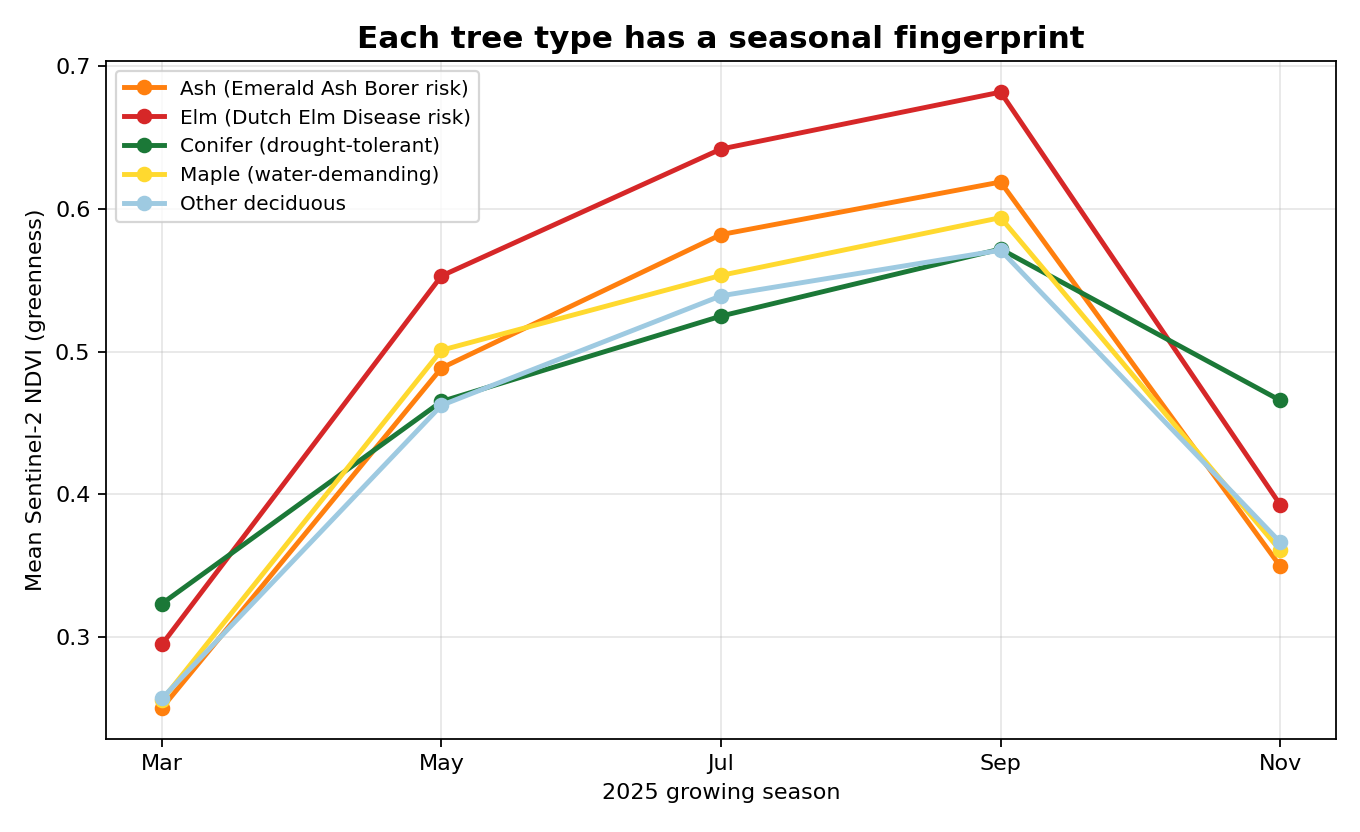
Five Sentinel-2 dates add seasonal behavior. Conifers stay green into November while deciduous crowns leaf out and fade, giving the classifier information a single summer image cannot provide.
Building the map
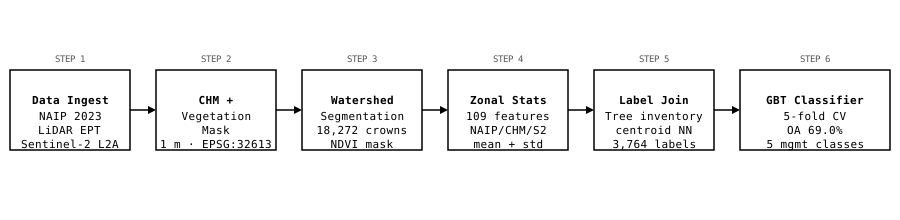
A vegetation-masked watershed splits the DRCOG LiDAR canopy-height raster into 18,272 crowns. Each crown stays one object through feature extraction and classification.
Each crown has 109 features from NAIP color and near-infrared, Sentinel-2 seasonality and vegetation indices, plus LiDAR height and shape. Matching crowns to Denver's arborist inventory produced 3,764 labels. Gradient boosting won a four-model comparison.
A look without labels
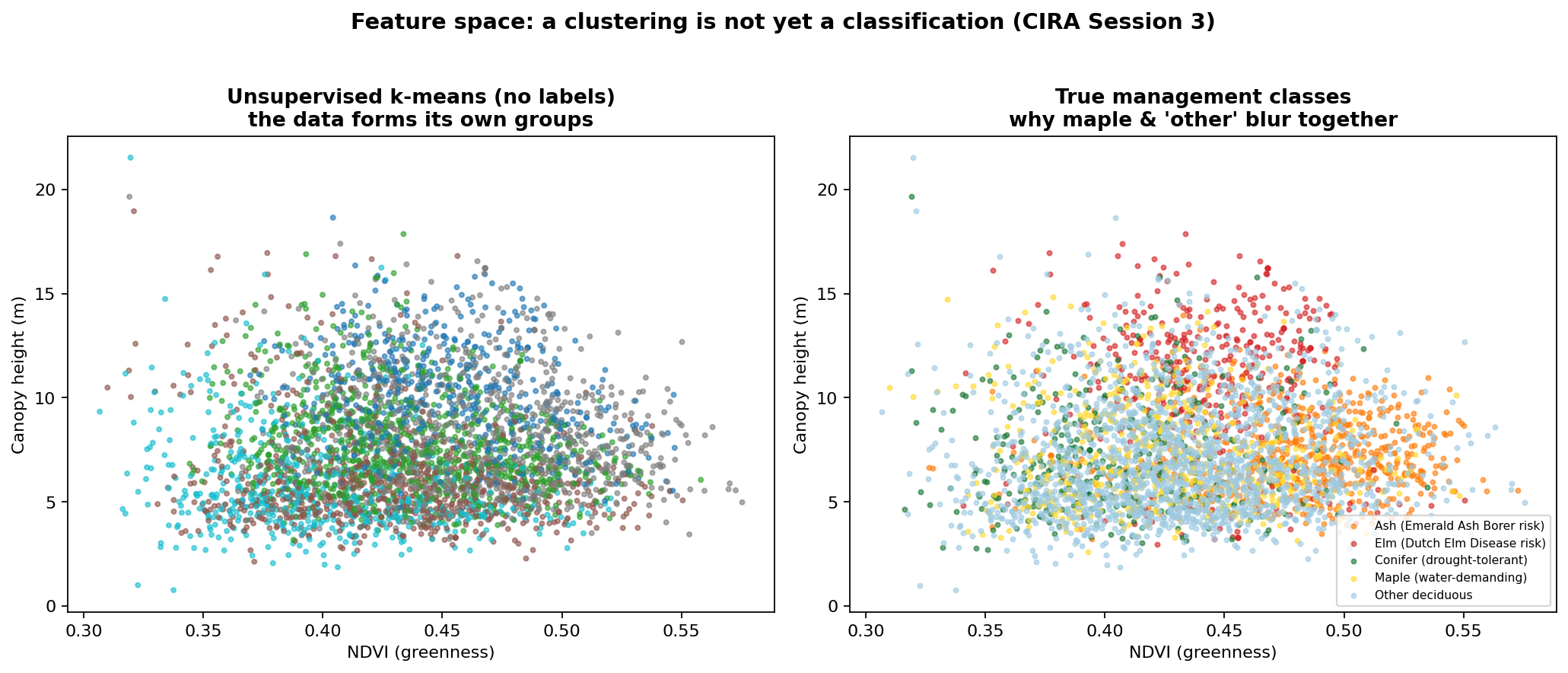
Unsupervised clustering shows structure in greenness and height, along with the main ambiguity: maple overlaps heavily with other deciduous crowns. The supervised model makes most of its errors there.
Results
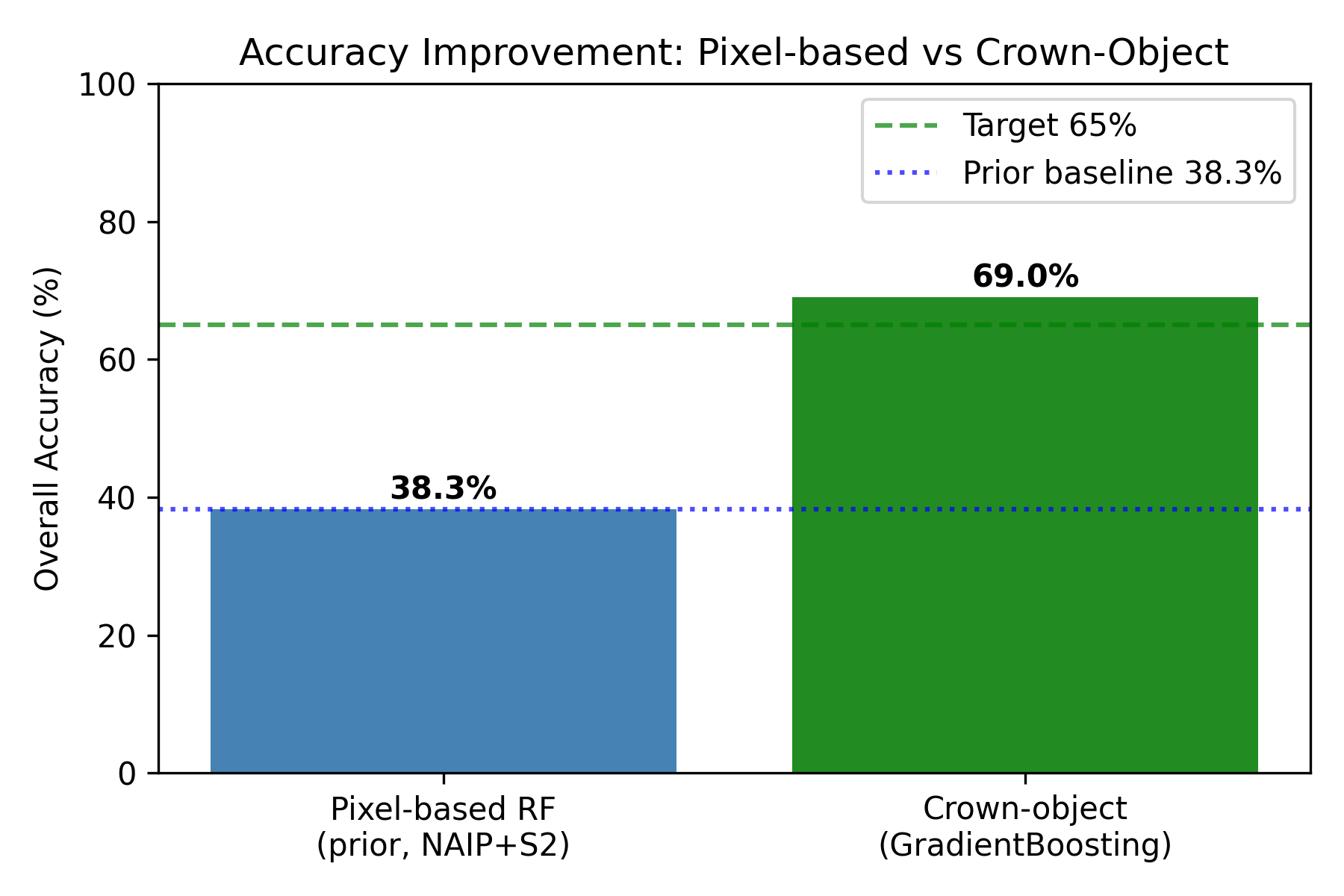
Overall accuracy is 69.0%, up from 38.3% for the pixel baseline. Balanced accuracy is 62.8%. Conifer and ash perform best; maple remains weakest because it overlaps other deciduous crowns.
| Management class | Precision | Recall | F1 | Crowns |
|---|---|---|---|---|
| Ash (Emerald Ash Borer risk) | 0.71 | 0.63 | 0.66 | 204 |
| Conifer (drought tolerant) | 0.84 | 0.71 | 0.77 | 120 |
| Elm (Dutch Elm Disease risk) | 0.77 | 0.57 | 0.65 | 118 |
| Maple (water demanding) | 0.69 | 0.39 | 0.50 | 180 |
| Other deciduous | 0.65 | 0.85 | 0.74 | 508 |
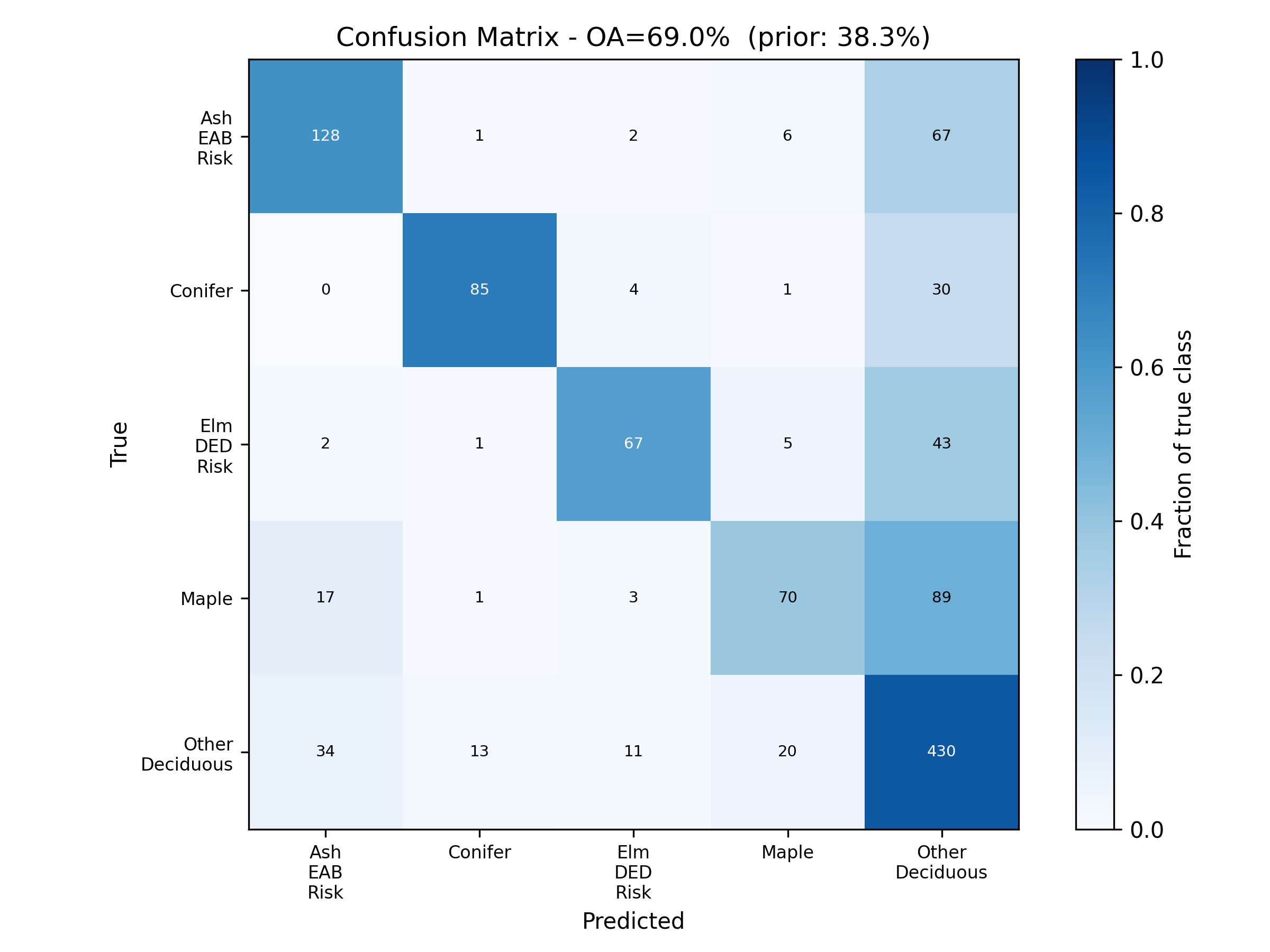
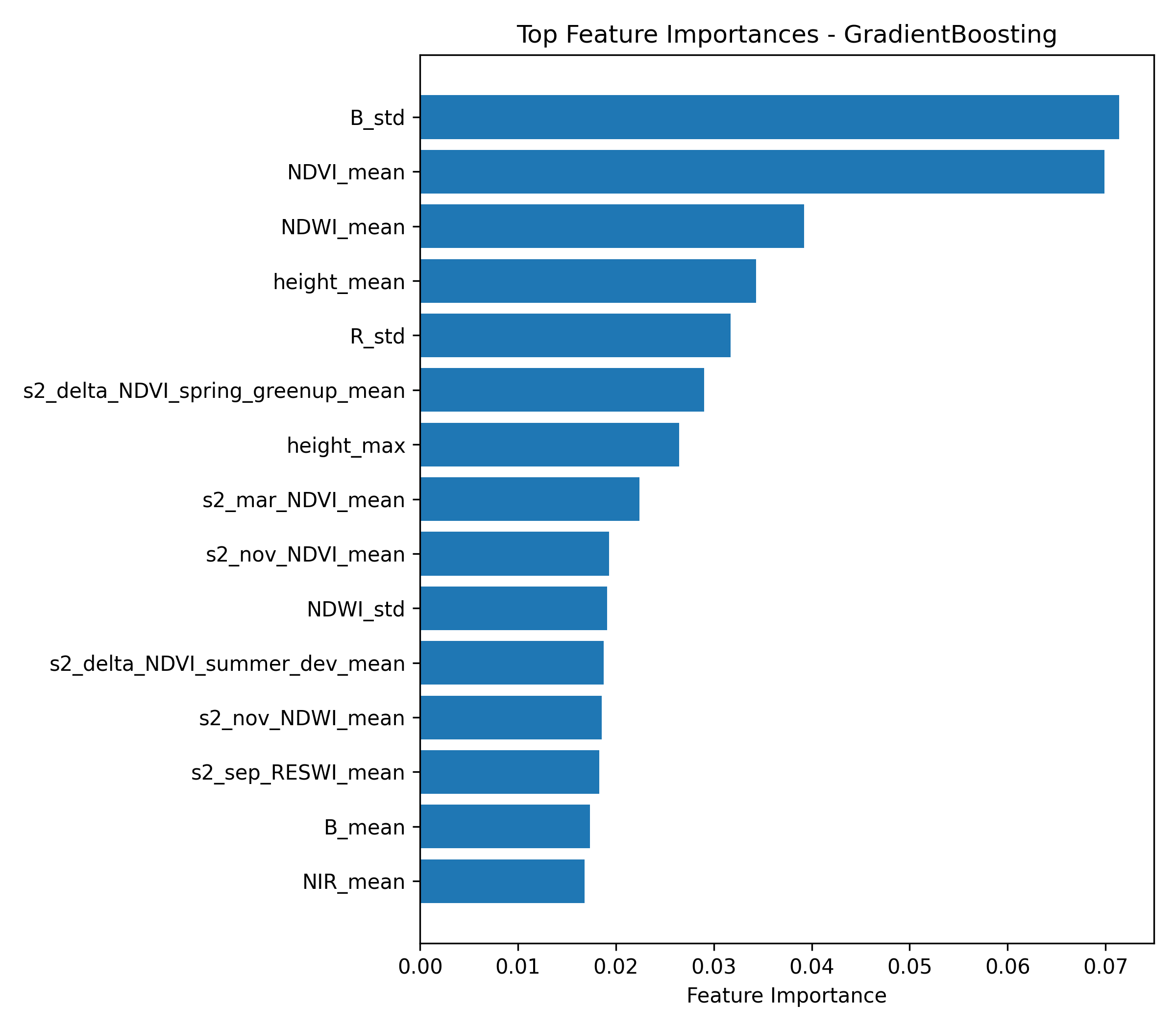
NAIP color and Sentinel-2 seasonality account for nearly nine tenths of feature importance; LiDAR height contributes about a tenth. Most separation comes from how crowns reflect light across bands and seasons.
Spatial validation
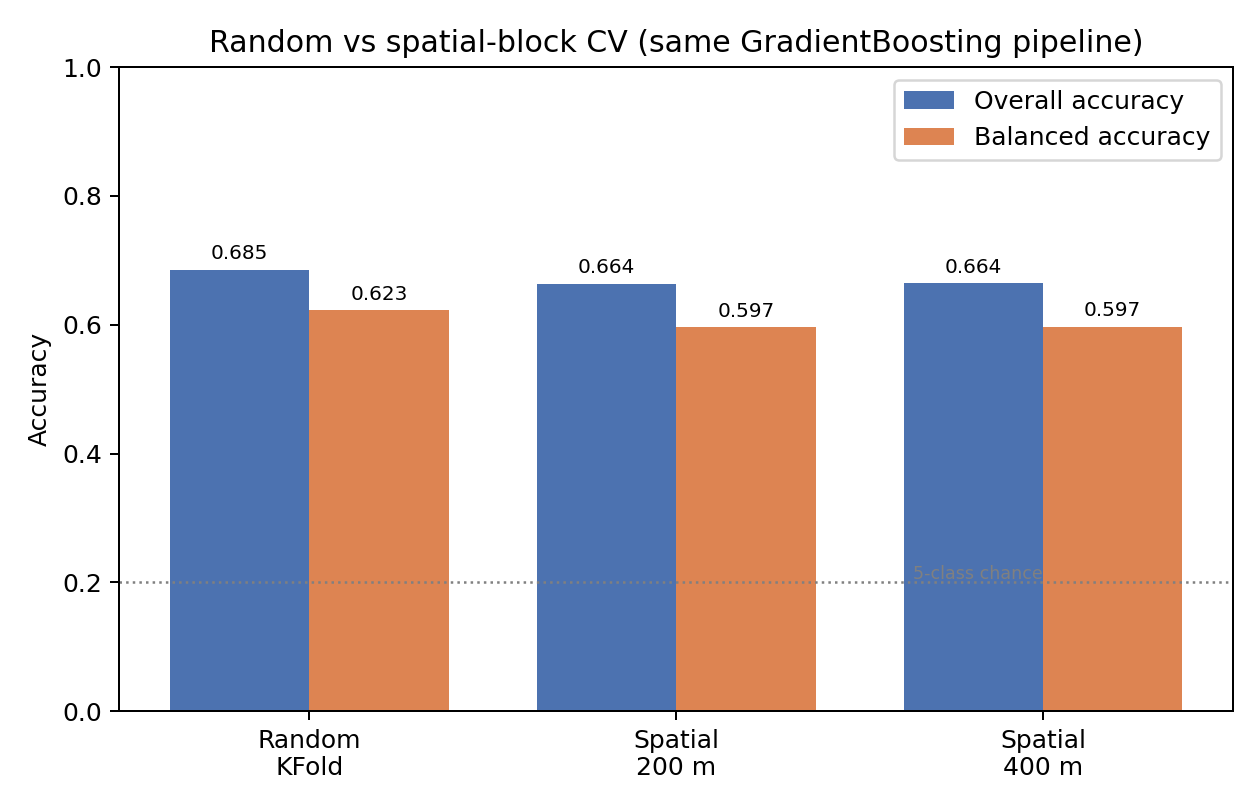
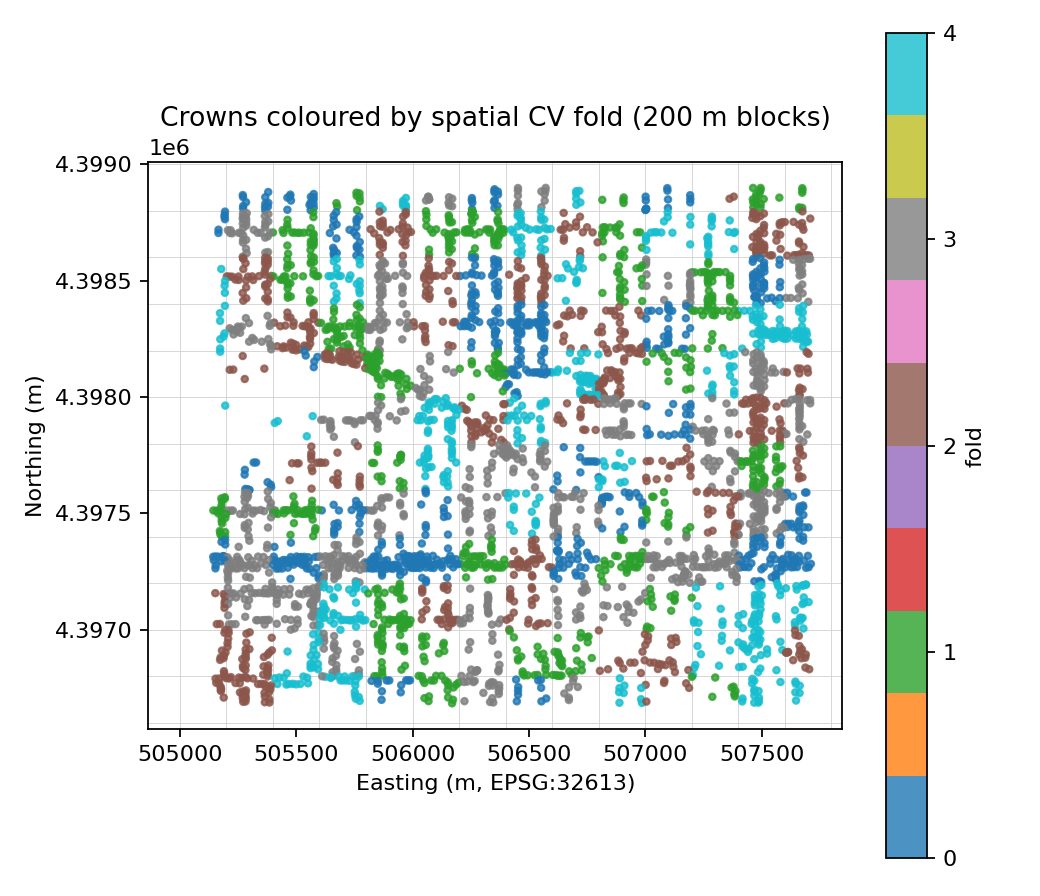
Random splits can flatter spatial models because nearby crowns share lighting and planting patterns. I therefore withheld complete 200 m and 400 m blocks during testing.
Accuracy holds at 66.4% for both block sizes, about two points below the random split. That supports use within Hale; it does not establish transfer to another neighborhood.
| Evaluation | Overall accuracy | Balanced accuracy |
|---|---|---|
| Random split, same model | 0.685 | 0.623 |
| Spatial blocks, 200 m | 0.664 | 0.597 |
| Spatial blocks, 400 m | 0.664 | 0.597 |
How far species can go
Crown-level classification across 21 sufficiently labeled species reached about 54% accuracy, compared with 17% for the pixel baseline. Blue spruce, American elm, honeylocust, and ash separate best; lindens, oaks, and ornamental maples often merge with similar broadleaf species.
That is useful for exploration, but not reliable enough for field identification. The five management classes remain the operational output.
From map to action
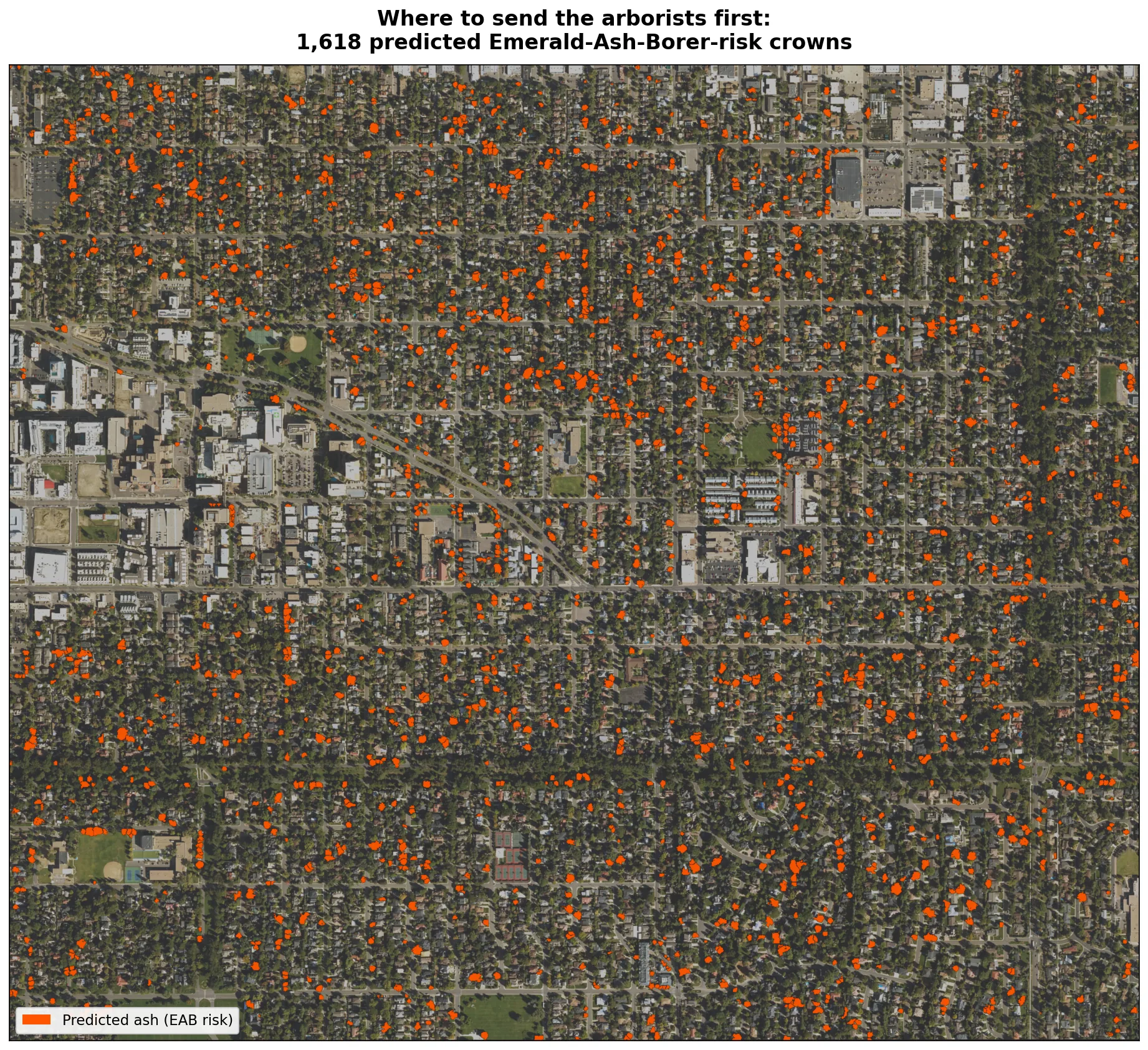
The model flags about 1,600 crowns as likely ash for field confirmation and treatment planning. Adding an October image improved ash recall by about seven points, making seasonal timing the most useful tested change for Emerald Ash Borer screening.
Canopy change, 2016–2025
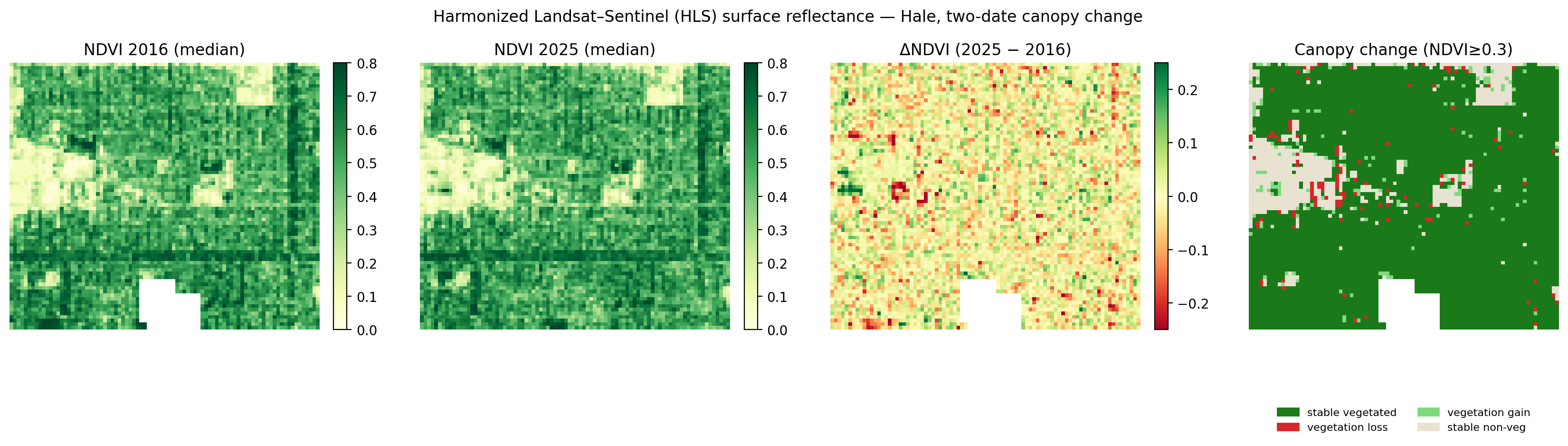
For change analysis I used NASA's Harmonized Landsat-Sentinel surface reflectance, which places both sensors on a common 30 m grid.
Cloud-free summer composites show a broadly stable neighborhood: about 2% vegetation loss and 2.5% gain. Small differences can also come from acquisition date and sun angle, so I do not interpret each changed pixel as a tree-level event.
A 30 m HLS pixel covers several trees and surrounding ground. It measures neighborhood change, while the one-meter workflow maps individual crowns.
Coarse-scale foundation model
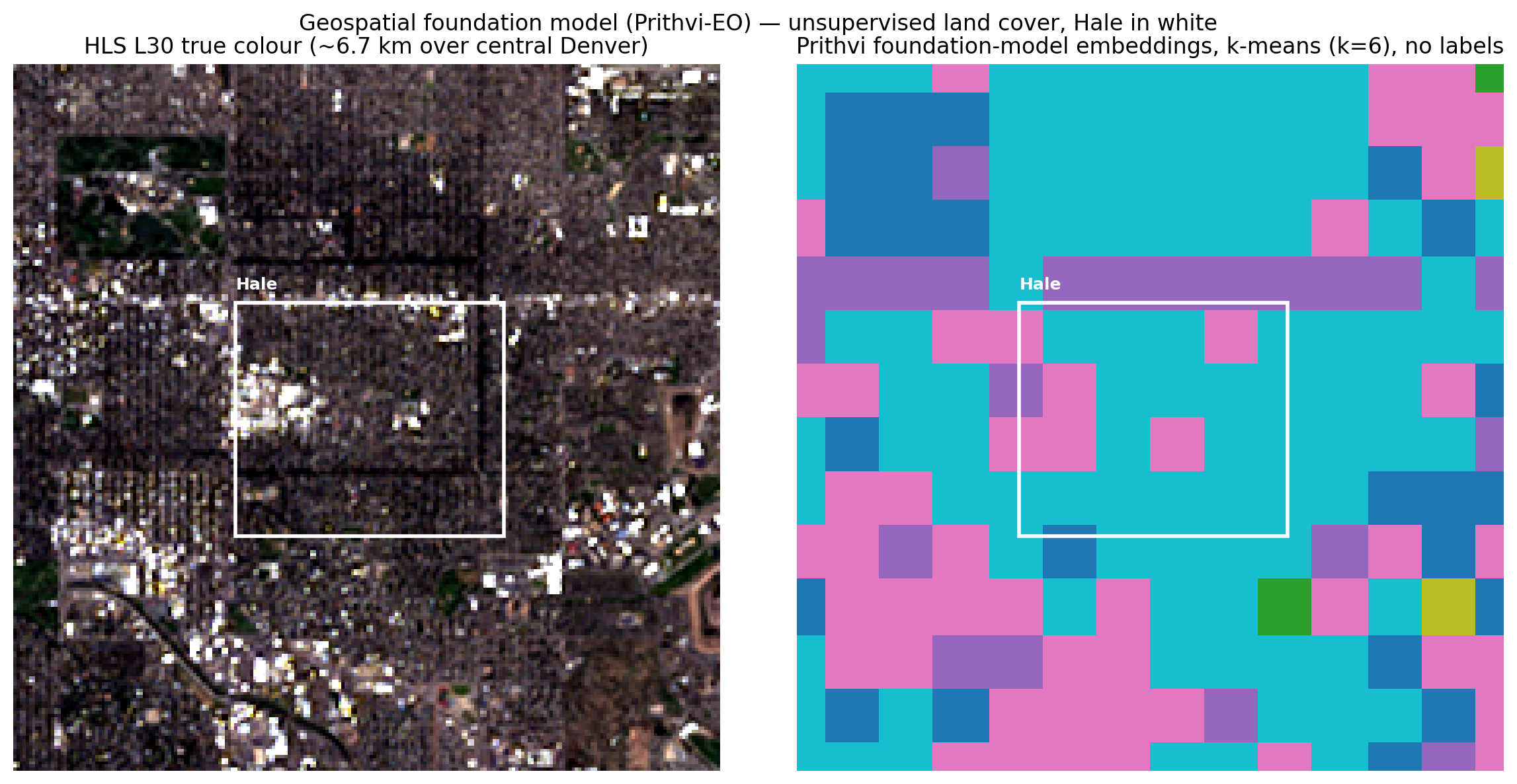
I ran NASA and IBM's Prithvi-EO model over six-band HLS imagery for central Denver, then clustered its learned features without labels. The published weights ran locally.
At roughly 480 m per patch, Prithvi separates broad land-cover patterns but misses tree-level variation. It is a useful coarse baseline, not a substitute for the one-meter crown workflow.
Crown-scale learned models
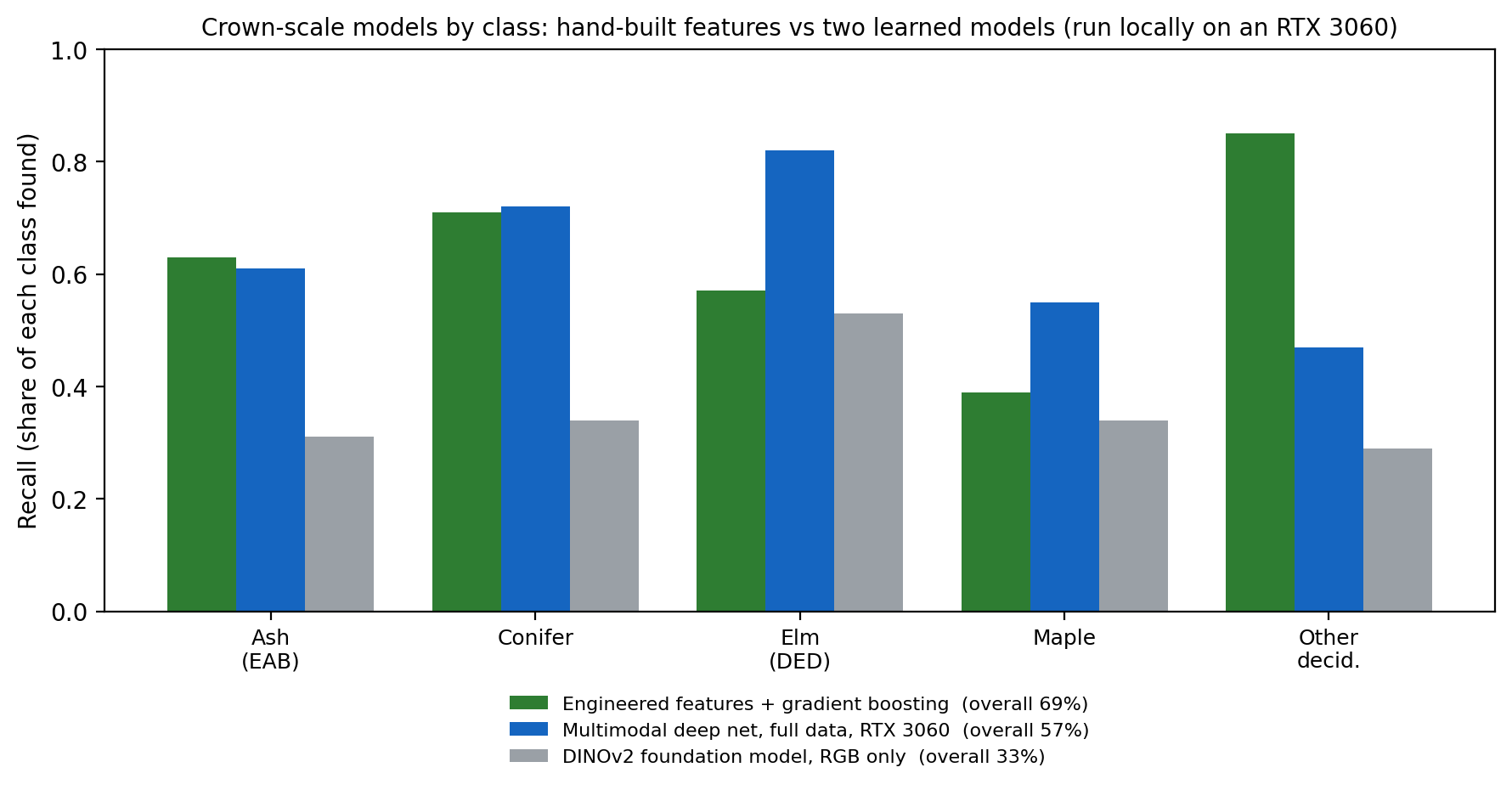
DINOv2 embeddings from one RGB aerial chip per crown reached 32.9% accuracy, well below the engineered feature model.
A purpose-built network combines RGB, near-infrared, LiDAR height, and the Sentinel-2 time series. It matches the engineered model on balanced accuracy and raises elm recall from 0.57 to 0.82 and maple from 0.39 to 0.55, while lowering overall accuracy.
With 3,764 labels, gradient boosting still leads overall. The multimodal network performs better on rare classes; the RGB-only foundation model lacks the spectral, seasonal, and height inputs the task needs.
| Crown-scale model | Overall accuracy | Balanced accuracy |
|---|---|---|
| Engineered features + gradient boosting | 0.690 | 0.628 |
| Multimodal deep net (full data, local GPU) | 0.569 | 0.632 |
| DINOv2 foundation model (RGB only) | 0.329 | 0.360 |
Data and tools
Every input is free and openly licensed. One script runs the pipeline. The crown-based method adapts Cross (2019) from WorldView-3 tropical forest imagery to public Denver data and urban-forestry classes.
| Dataset | Source | License |
|---|---|---|
| NAIP 2023 aerial imagery (4 band, 30 cm) | USDA NRCS, via AWS | Public domain |
| Denver tree inventory (arborist survey) | Denver Open Data Portal | CC BY |
| Canopy height model | DRCOG 2020 3DEP airborne LiDAR | Public domain |
| Sentinel-2 surface reflectance, 5 dates | ESA Copernicus | Free, open |
| HLS surface reflectance (L30/S30, 30 m) | NASA LP DAAC, via Earthdata | Free, open |
Built with Python, Rasterio, GeoPandas, scikit-image, scikit-learn and XGBoost, with QGIS for inspection. Everything ran on one desktop machine: the feature pipeline on the CPU, the neural networks on a single RTX 3060. The pretrained models it draws on were downloaded and run there too. Study area: the Hale neighborhood, about 4.6 square kilometers.
Source available on request.